

Arya Samaj Marriage
It is surprising how many couples, even today, prefer a quiet marriage over a grand one. When they picture their wedding, they imagine something calm. A small room. A priest who speaks gently. A moment where both partners can hear themselves think.
Arya Samaj Marriage offers exactly that. Nothing loud. Nothing heavy. Just a simple start that still carries the weight of tradition.
Rooted in the teachings of Swami Dayananda Saraswati, the Arya Samaj philosophy values truth and straightforwardness. You sense it the moment you step into an Arya Samaj Mandir. The space feels steady. The staff speaks plainly. There is no rush to impress.
Many couples arrive with a mixture of excitement and worry, holding their documents tight. Yet the process unfolds gently. Someone checks the details. Someone guides them to the ceremony room. It feels organised without being rigid, which is rare in most wedding settings.
What the Ceremony Tries to Convey
An Arya Samaj Marriage is not designed for an audience. It is for the couple. The mantras highlight trust, responsibility and partnership. Nothing decorative is added just for appearance.
That simplicity often makes the moment more powerful. Couples understand what is happening instead of merely performing rituals.
Who Can Marry Here
The rules are simple.
- One partner must be Hindu, Sikh, Jain or Buddhist
- Both partners must meet the legal age requirement
- Neither should already be married unless divorced or widowed
- Consent must be genuine
- Inter-religion couples may opt for the Shuddhi ceremony if they wish
What You Need to Carry
- Proof of age
- Proof of address
- Passport-size photographs
- Two witnesses with valid identification
- Affidavit confirming nationality and marital status if required
If someone was married earlier, supporting documents are necessary. Most couples finish this step faster than expected.
A Glimpse of the Ceremony
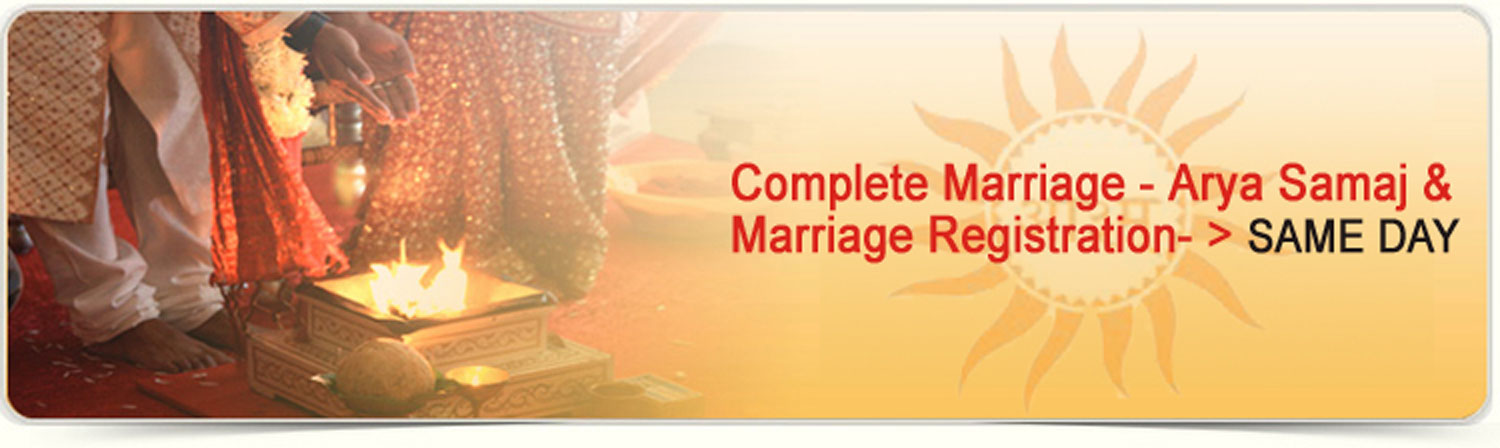
When the ceremony begins, there is a quiet shift in the room. A small fire is lit. The priest chants in a steady tone. The couple exchanges garlands and takes the seven steps around the sacred fire.
Each step is explained in simple words. Nothing feels rushed or staged. Once the ritual ends, the Mandir hands over a certificate confirming the marriage.
Why Registration Still Matters
While the ceremony is legally valid under the Hindu Marriage Act or the Special Marriage Act, government procedures such as passports or visas usually require an SDM-issued certificate.
This is why most couples visit the SDM office after the ceremony to complete registration.
The Cost and Why It Appeals to Many
Arya Samaj weddings remain affordable. The fee generally covers the ceremony, document checking and the Mandir certificate. For couples who want meaning without financial pressure, this path makes sense.
Clearing a Few Confusions
- Arya Samaj marriages are legally valid once registered
- Inter-faith couples may marry through Shuddhi or the Special Marriage Act
- The process usually takes only a few hours
- Parental approval is not mandatory for consenting adults
Why Couples Keep Returning to This Path
Couples often remember the stillness of the Mandir, the calm guidance of the priest and the clarity of the process. Nothing feels mechanical. The legal certainty afterward adds a sense of security at the very start of married life.
Legal Validity — Ceremony vs Registration
Many couples get confused between the Arya Samaj ceremony and legal registration. Both are separate steps and serve different purposes.
- The ceremony performed in the Arya Samaj Mandir is the solemnisation of marriage
- The Mandir certificate confirms that the ritual marriage took place
- For most government and legal work, the SDM-issued marriage certificate is required
The SDM marriage certificate is generally needed for:
- Passport and visa applications
- Bank and nomination updates
- Court and legal documentation
- Official identity verification
The Mandir certificate supports the process, but it does not replace government registration.
When Arya Samaj Marriage May Not Be the Right Option
Arya Samaj marriage is simple and meaningful, but it is not suitable for every situation. It may not be the best choice if:
- One partner is a foreign national
- Visa or immigration matters are involved
- Court protection or police assistance may be required
- There is a high chance of family dispute or objection
- Religious identity or conversion may be questioned later
- Personal records or documents have inconsistencies
In such situations, many couples choose the Special Marriage Act (SMA) because it provides a neutral and clearer legal framework.
Shuddhi (Conversion) — Practical Clarification
Some inter-faith couples consider Arya Samaj marriage through Shuddhi, where one partner converts to Hindu faith before the ceremony.
Important points to understand:
- Conversion should be voluntary and based on personal choice
- It should not be done only to bypass legal procedures
- Conversion may be questioned later in sensitive family situations
- Related documents may be reviewed carefully during registration
Many inter-religion couples prefer the Special Marriage Act instead because it does not require religious conversion and reduces future disputes.
Documents — Practical Risks and Real-World Issues
Even small mistakes in documents can cause delays or re-verification. Common issues include:
- Name spelling mismatch across documents
- Witnesses arriving without original ID proof
- Signatures not matching existing identity records
- Incomplete affidavits or unclear photocopies
Reviewing documents carefully in advance helps avoid last-minute problems.
Fraud and Safety Awareness
Couples should be cautious in situations such as:
- Someone promising instant valid marriage without explaining conditions
- Certificate validity being claimed without registration
- Fees being taken without receipts
- Blank affidavits being asked to sign
- Mandir identity or trust registration not being clear
It is safer to:
- Verify the Mandir
- Ask for transparency in every step
- Keep copies of all submitted documents
Marriage is a lifelong legal responsibility — clarity protects both partners.
Why Registration After Ceremony Is Important
After the Arya Samaj ceremony, most couples complete marriage registration at the SDM office.
This helps:
- Create an official government marriage record
- Prevent document conflicts in future
- Provide stable and verifiable legal proof
Processing time may vary depending on:
- The applicable marriage act
- The type of documents submitted
- Workload of the SDM office
It is safer to treat registration as an essential step, not an optional one.
Frequently Asked Questions — Arya Samaj Marriage
1. Is Arya Samaj marriage legally valid in India?
Yes, Arya Samaj marriage is recognised under the Hindu Marriage Act, 1955 and the Arya Marriage Validation Act, 1937. The Mandir issues a solemnisation certificate after the ceremony.
However, for many government and legal processes, couples may still be required to obtain an SDM-issued marriage certificate. Registration provides stronger and widely accepted legal proof.
2. Who can get married in an Arya Samaj Mandir?
Arya Samaj marriage is generally meant for:
- Hindu
- Sikh
- Jain
- Buddhist couples
Inter-caste marriages are accepted. Inter-faith couples may marry after voluntary conversion (Shuddhi), but this should be a personal decision and not only for paperwork.
3. Can inter-religion couples get married through Arya Samaj?
Yes, some inter-faith couples marry after the Shuddhi (conversion) ceremony. Important points to understand:
- Conversion must be voluntary
- It may be reviewed during registration
- Future disputes may question intent
Because of this, many couples prefer the Special Marriage Act (SMA), as it does not require conversion and is legally neutral.
4. Is the Arya Samaj Mandir certificate enough for passport or visa?
In some cases it is accepted, but many authorities ask for an SDM-issued marriage registration certificate. The Mandir certificate is valid, but registration provides stronger documentation and helps avoid delays.
5. How long does Arya Samaj marriage take?
The ceremony and documentation generally complete within 2–3 hours in normal cases. However, the timeline may vary depending on:
- Document verification
- Witness availability
- Eligibility conditions
- Workload of authorities
No fixed time should be assumed for every case.
6. What documents are required for Arya Samaj marriage?
Commonly required documents include:
- Aadhaar Card / Passport / Voter ID
- Birth Certificate / 10th Marksheet / Passport (age proof)
- Passport-size photographs
- Two witnesses with valid ID
- Divorce decree or spouse death certificate (if applicable)
- Conversion certificate for Shuddhi cases
Details must match correctly to avoid delays.
7. Do parents need to give permission for Arya Samaj marriage?
No, if both partners are legally adults, mentally sound, and giving free and voluntary consent, parental approval is not legally required. However, authorities may verify identity and consent more carefully in sensitive situations.
8. Is Arya Samaj marriage suitable for NRI or foreign nationals?
It depends on the case. Additional documents may be required, such as:
- Passport and visa details
- Country-specific records
- Embassy or FRRO-related paperwork
Processing time is usually longer than regular cases, so confirming requirements in advance is safer.
9. Is Arya Samaj marriage the same as court marriage?
No, both are different types of marriage:
- Arya Samaj marriage — Vedic ritual solemnisation
- Court marriage — Civil marriage under the Special Marriage Act
Many couples marry in Arya Samaj Mandir and later complete SDM registration.
10. Do witnesses need to be family members?
No, witnesses do not need to be relatives. They must be adults, carry original ID proof, and be present during signing. Friends or colleagues can also act as witnesses.